
When Is the Best Time to Prune Trees in Western Washington?
There is no single best time for every tree. The Washington State University Extension handbook describes the dormant season as usually a good time to prune, but spring-flowering plants are best pruned right after they bloom, late summer and early fall are generally avoided, and dead or damaged branches can be removed at almost any time. Identify the plant and your goal first.
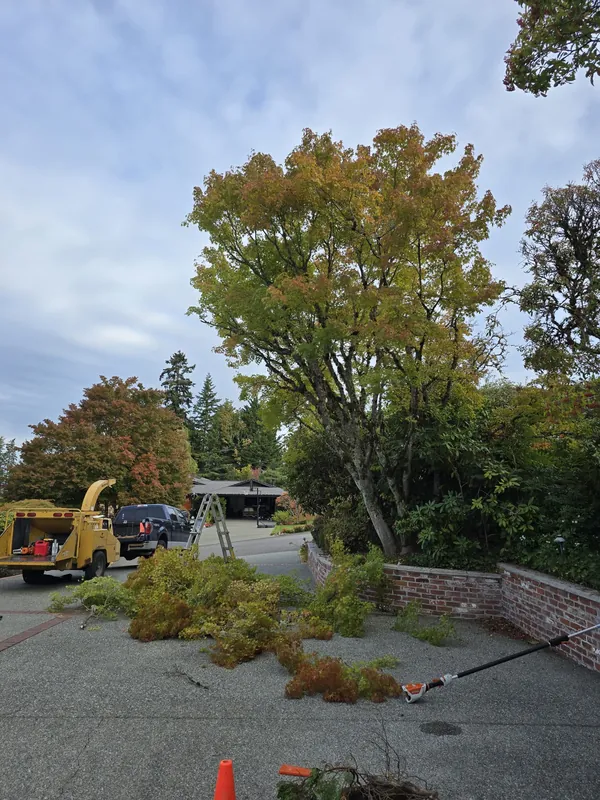
An ornamental tree on a residential property with pruning cleanup in progress. Timing depends on the species and the purpose of the cut.
Homeowners in Renton and across Western Washington often ask when to prune, and they usually hope for one clean answer. The truth is that the best timing depends on the plant, the goal, and the reason for the cut. This guide draws on the Washington State University Extension Pacific Northwest Gardener's Handbook chapter on pruning woody landscape plants to explain the general timing principles, where they change, and when it makes sense to have someone look at the tree in person.
Is Dormant-Season Pruning a Good Default?
For many woody plants, yes. WSU describes the dormant season as usually a good time to prune. Pests are generally inactive, and on deciduous trees the bare structure is easier to read, which helps you see which branches are crossing, rubbing or poorly attached. WSU also notes that late winter is generally better than early winter, because very cold weather can injure freshly exposed tissue.
"Generally good" is not "right for everything," and the sections below show why.
What About Spring, Summer and Fall?
Spring and summer can also be fine for pruning, but WSU points out that pests are active then, so fresh wounds can be more vulnerable. Opening up a canopy that was shaded can expose tissue to sun, which can lead to sun scald, and heavy pruning just before very hot weather is best avoided.
WSU specifically advises against pruning in late summer and early fall. Pruning then can stimulate new shoots that may not harden off before winter. The handbook suggests pruning earlier in the summer or later in the fall to avoid that situation.
Flowering Trees and Shrubs Follow Their Own Calendar
If a plant is grown for its blossoms, when you prune can decide whether you get flowers. WSU divides flowering plants into three groups:
- Spring bloomers set flower buds the previous summer. WSU lists rhododendron, forsythia and lilac as examples and notes that dormant-season pruning will remove their flower buds. To keep the flowers, prune right after they finish blooming, through early summer.
- Summer bloomers flower on the current season's growth. WSU lists lavender, elderberry, potentilla and rose of Sharon as examples and says they can be pruned through the dormant season without removing flower buds.
- Mixed or variable bloomers such as clematis, hydrangea, spirea and rose may flower on old or new growth depending on species or cultivar. WSU says these need to be identified before the best time to prune can be determined.
Timing at a Glance
This table summarizes the WSU guidance. It is a general reference, not a schedule for any particular tree.
Swipe to view more columns
| Situation | General Timing Guidance | Caution |
|---|---|---|
| Most deciduous trees (structure and form) | Dormant season is usually a good time, and late winter is generally better than early winter. | Plant species and goals still matter. |
| Spring-flowering plants | Right after flowering, through early summer. | Dormant pruning removes flower buds. |
| Summer-flowering plants | Can be pruned through the dormant season. | Late spring or summer cuts may remove buds. |
| Dead or damaged branches | Deadwood can be removed at almost any time. | Avoid exposing shaded tissue during extreme heat or cold. |
| Late summer to early fall | Generally avoided. | May trigger new growth that does not harden before winter. |
| Pest-susceptible species | Time the work to minimize risk to the plant. | WSU cites birch and the bronze birch borer, which is attracted to fresh cuts from late April through mid-July. |
Damaged or Dead Limbs: Do You Have to Wait?
Generally not. WSU says deadwood can be removed at almost any time, with the caveat about extreme heat or cold. It also says that when pruning mostly removes deadwood, or less than 10 percent of the live tissue, timing should not be a concern. The more important issue with broken or hanging limbs is safety. WSU states that safety is the top priority, even if that means removing an entire plant. A limb that is cracked, hanging or leaning over a roof, driveway or play area should be looked at promptly and not saved for a convenient season.
When Does a Professional Assessment Make Sense?
The handbook recommends a certified arborist for structural pruning of mature trees, for assessing whether a tree is a hazard, for large trees or work that requires climbing, and any time the job exceeds your physical ability, technical skill or knowledge. It also says homeowners should never attempt to prune branches within ten feet of a power line, and that only certified utility arborists should do that work. If your tree is near wires, read our guide to branches near power lines.
An on-site visit lets someone look at the actual tree, identify species, see what has been cut before and talk through what you want to achieve. It is also the right moment to ask any contractor about their training and credentials.
Pruning or Trimming? Using the Right Term for the Job
The two words are often used interchangeably, but they describe different goals. Our guide on the difference between tree trimming and pruning explains how to describe what you want, and our service pages cover tree pruning for selective, health- and structure-focused cuts and tree trimming for clearance and shaping.
Frequently Asked Questions
Is winter always the best time to prune?
No. WSU describes the dormant season as usually a good time, but not for every plant. Spring-flowering shrubs and trees pruned in winter will lose flower buds, and some species have pest-related timing concerns.
Can I prune in summer?
Often, yes. WSU says spring and summer are generally good times to prune, with cautions about pests, sun exposure and extreme heat. It advises avoiding late summer and early fall.
Can dead branches be cut any time of year?
WSU says deadwood can be removed at almost any time, other than during extreme heat or cold. If a dead branch is large or overhangs a structure, have it assessed instead of attempting it yourself.
How do I know when my tree should be pruned?
Identify the plant first, then match timing to the goal. If you are unsure of the species or the goal, a professional assessment is a practical next step.
Not Sure Which Pruning Window Fits Your Tree?
Just For Trees LLC provides residential tree pruning and tree trimming across Renton and surrounding communities. As a Renton-based company at justfortreesllc.com, we offer free on-site estimates. Call (253) 553-8953 or request a free estimate online, and we can look at the tree with you.
Sources & Further Reading
- Washington State University Extension: Pacific Northwest Gardener's Handbook, Chapter 23: Pruning Woody Landscape Plants. Available at: https://extension.wsu.edu/pnw-gardeners-handbook/chapter-23-pruning-woody-landscape-plants/