7 Signs It May Be Time to Discuss Tree Removal
Visible conditions such as extensive canopy dieback, significant trunk damage, recent root movement, or major broken branches may be reasons to discuss a tree's condition and possible removal options. However, no single physical symptom automatically means removal is required. Depending on the tree, species, and surrounding landscape, selective pruning or other tree care methods may sometimes be considered.
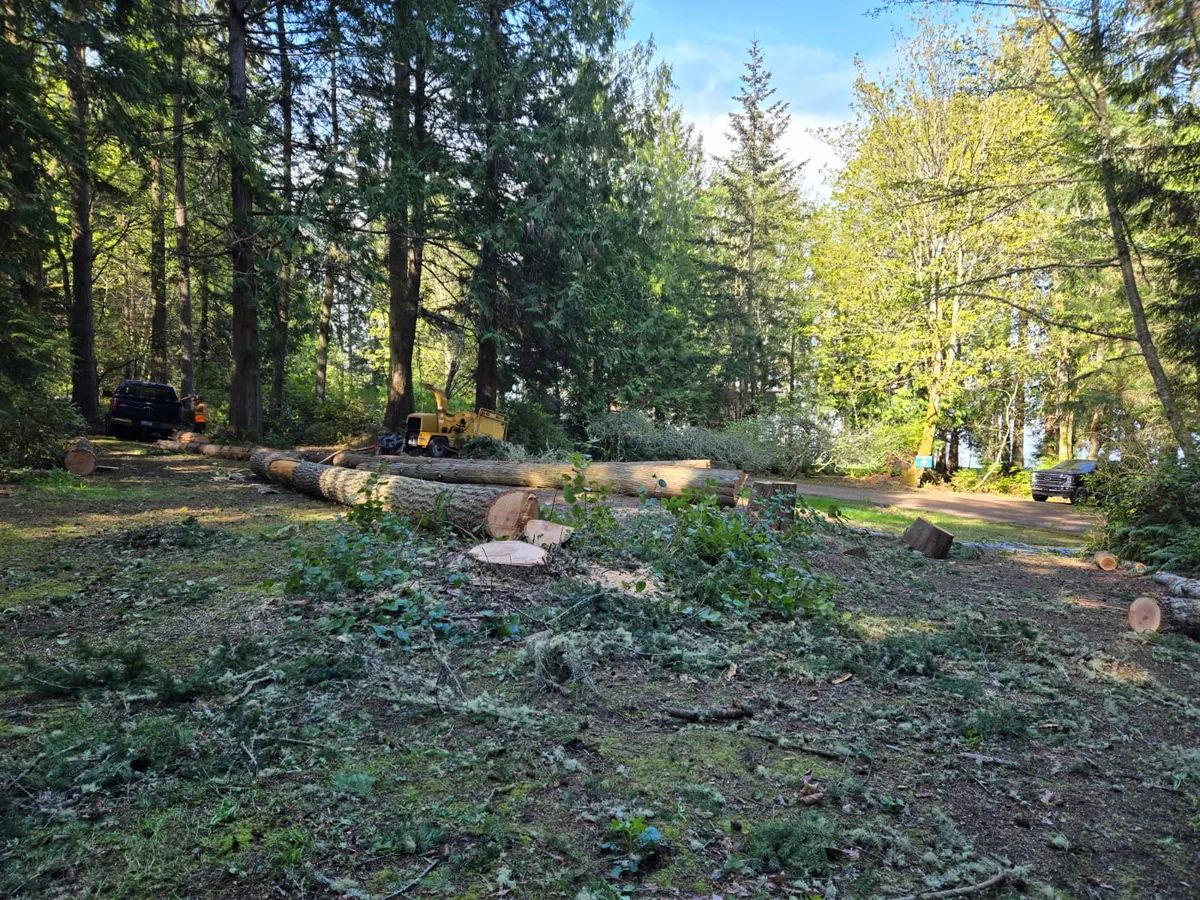
Cut tree trunk sections resting on a residential lawn during residential tree removal.
Trees provide valuable shade, aesthetic beauty, and property value to residential landscapes across the Puget Sound region. However, as trees mature, experience severe weather, or encounter environmental stress, property owners often notice visible changes that raise questions about safety and long-term tree health.
Recognizing noticeable physical changes is an important part of responsible homeownership. This educational guide explores seven observable conditions that commonly prompt property owners to evaluate their trees and discuss whether maintenance, selective pruning, or complete removal makes sense for their property.
Does One Warning Sign Mean a Tree Must Be Removed?
The simple answer is no. In arboricultural science and forestry literature, observing a physical defect or symptom is an observation, not an automatic conclusion that a tree must be cut down.
Whether a tree should be removed or managed with other tree care methods depends on multiple interrelated factors:
- Overall tree condition and vitality: How much living, healthy foliage and active vascular tissue remains.
- Extent and location of visible damage: Where the defect is located (such as lower trunk vs. an individual upper branch).
- Surrounding property targets: Proximity to homes, driveways, outdoor living areas, or property lines.
- Root system stability: Whether anchoring roots remain undisturbed in the soil.
- Available management alternatives: Whether selective branch pruning, crown cleaning, or monitoring can resolve the concern.
1. Extensive or Increasing Crown Dieback
The canopy reflects the overall vascular health and energy production of a tree. When substantial portions of the upper crown fail to produce leaves or exhibit dead, leafless branches over multiple growing seasons, it indicates the tree is experiencing significant stress or decline.
Observable signs of canopy decline include large dead limbs in the upper third of the tree, unusually sparse foliage during the peak summer growing season, or premature leaf discoloration and drop across multiple main branches.
Dead vs. Dormant: Why a Single DIY Test Is Inconclusive
Property owners sometimes wonder whether a bare tree in winter or early spring is dead or simply dormant. Authoritative resources from university extensions, such as the University of Maryland Extension, emphasize that individual DIY observations—such as scratching bark to look for green cambium tissue or bending small twigs—provide only localized clues.
Seasonal cycles, species traits, summer drought, and temporary insect defoliation can cause leaf drop without whole-tree death. Homeowners should avoid making irreversible removal decisions based on a single scratch test or winter appearance.
2. Significant Trunk Cracks, Cavities, or Visible Decay Indicators
The main trunk serves as the primary structural column supporting the entire weight of the canopy. Deep cracks, large cavities, or open hollows on the main stem indicate areas where wood tissue has been damaged or decayed.
According to publications by the USDA Forest Service and the University of Minnesota Extension, trees compartmentalize internal decay by forming natural chemical and physical boundary walls.
- Cavities and hollows: A cavity or hollow area can be associated with past damage or decay and may deserve further attention. If an adequate outer cylinder of sound wood remains, a tree may maintain structural strength for years.
- Deep vertical cracks: Longitudinal cracks that extend deep into the wood or appear on opposite sides of the trunk warrant on-site review.
Fungal Fruiting Bodies on or Near the Trunk
Fungal fruiting bodies on or near the trunk or root flare (such as conks or mushrooms) can be associated with wood decay and may warrant further attention. While fungi signify internal wood breakdown, the species of fungus, its location, and the remaining sound wood volume determine its structural significance. The presence of mushrooms alone does not provide a definitive timeline or dictate automatic removal.
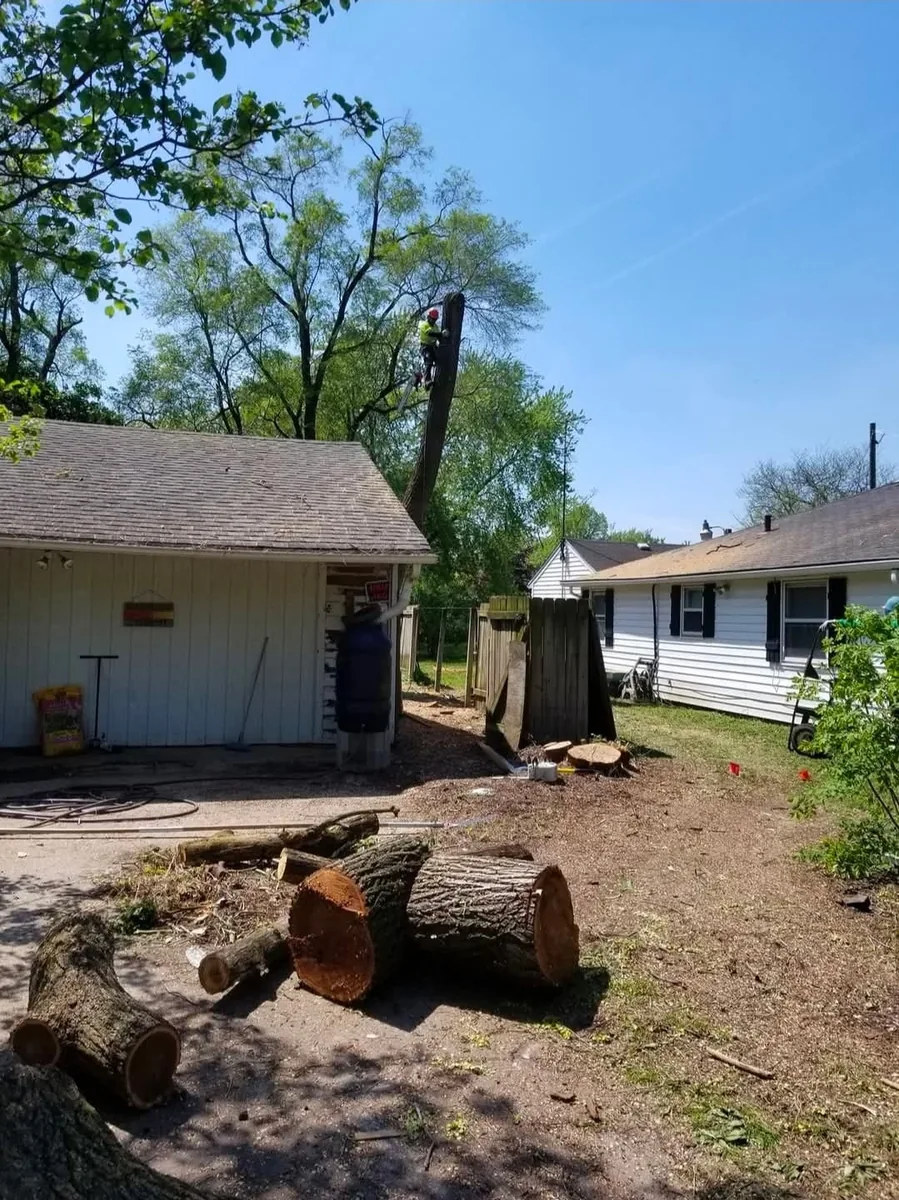
Tree sections being cut or removed in a residential yard during planned property management.
3. A Newly Changed Lean With Visible Soil or Root-Plate Movement
Trees naturally grow with sweeps, bends, or leans as they seek sunlight (*phototropism*). A long-standing lean does not, by itself, prove that a tree is unstable, as trees often build reaction wood to support angled growth.
However, a newly changed lean that develops following heavy rains, winter storms, or high winds represents a fundamentally different situation:
- Mounded or heaving soil: Ground lifted or bulging on the side opposite the lean indicates the root plate is shifting.
- Cracked soil or exposed fresh roots: Visible soil fissures or freshly torn fine roots suggest recent movement and loss of ground anchoring.
A newly developed lean accompanied by soil movement deserves prompt on-site attention.
4. Significant Recent Root Damage or Soil Disturbance
Roots provide both water uptake and physical structural anchorage. Severe disturbance to the root system can compromise a tree's stability and long-term health.
Common scenarios involving significant root disturbance include:
- Recent trenching or excavation: Installing utility lines, foundations, retaining walls, or driveways close to the base of a mature tree.
- Visibly severed large structural roots: Cutting major anchoring roots reduces the tree's resistance to wind loads.
- Severe soil compaction or grade changes: Adding heavy layers of fill soil over the root area can restrict oxygen flow and induce root decline.
5. Large Broken or Damaged Main Branches
Severe storms, heavy wet snow, or internal weakness can cause large scaffold limbs to snap or tear away from the main trunk. When a major structural branch fails, it leaves an open wound and can significantly alter the tree's weight balance.
However, losing a single large limb does not automatically mean the entire tree must be removed. Depending on the remaining structure, canopy balance, and overall tree vitality, selective branch removal or corrective pruning may sometimes be considered instead of complete tree removal.
6. Major Stem or Branch-Union Defects
When trees develop multiple main trunks of similar size (*codominant stems*), the connection between those stems requires careful observation.
According to guidelines from Purdue University Extension, stem unions that exhibit included bark (bark pinched tightly inside the seam between growing stems) lack interlocking wood fibers.
When included bark is combined with deep vertical cracks, decay pockets, or visible separation along the union seam, the junction has an increased tendency to split under heavy wind or snow loads.
7. Serious Conflicts With Structures or Property Use That May Be Difficult to Manage
Sometimes a tree's health is acceptable, but its physical location creates persistent, unmanageable conflicts with residential infrastructure or property use:
- Direct contact with buildings: Heavy limbs constantly rubbing against roofs, gutters, or siding where pruning cannot provide adequate clearance.
- Severe driveway or walkway obstruction: Trunks that have outgrown tight property boundaries or completely block essential vehicle access.
- Substantial underground interference: In situations where roots significantly disrupt foundation walls or drainage systems and space is severely constrained.
When Might Tree Removal Not Be Necessary?
Complete tree removal is an irreversible decision. In many residential property situations, management alternatives exist that can address homeowner concerns while preserving the tree:
- Selective Branch Pruning: Removing dead, diseased, or broken limbs while retaining the healthy trunk and structural canopy. Homeowners can explore the differences in techniques in our overview of tree trimming vs. pruning.
- Clearance Trimming: Selectively cutting back specific branches to establish safe clearance from roofs, power drops, or structures.
- Crown Cleaning and Weight Reduction: Removing heavy end-weight on overextended limbs to reduce mechanical stress during wind events.
- Periodic Monitoring: Observing a tree across successive growing seasons to evaluate whether foliage vigor improves or stabilizes before making removal decisions.
Tree Condition Summary: Observations, Context, and Sensible Next Steps
Use this reference table to understand what common tree conditions may indicate and what sensible next steps to take:
| Observation | Why It May Deserve Attention | Possible Next Step | What It Does NOT Prove |
|---|---|---|---|
| Extensive canopy dieback | May indicate root stress, vascular decline, or past severe defoliation. | Request an on-site estimate to evaluate tree condition. | Does not prove the entire tree or root system is dead. |
| Large trunk cavity or hollow | A cavity or hollow area can be associated with past damage or decay and may deserve further attention. | Have remaining sound trunk structure reviewed on site. | Does not prove the trunk lacks strength or will fail. |
| Fungal fruiting bodies at base | Fungal fruiting bodies on or near the trunk or root flare can be associated with wood decay and may warrant further attention. | Discuss stability and management options on site. | Does not determine the exact speed or depth of decay. |
| New lean with disturbed soil | May indicate recent root-plate movement, particularly when accompanied by lifted, cracked, or disturbed soil. | Keep area clear; contact a tree service promptly. | Does not mean long-standing natural leans are unsafe. |
| Large broken main branch | A large broken branch may create a concern for the surrounding area, depending on its position and remaining attachment. | Discuss whether selective pruning can resolve the issue. | Does not prove the entire tree must be removed. |
| Stem union with included bark or cracks | Included bark, cracks, separation, or decay at a major stem union can be conditions worth discussing during an on-site review. | Discuss pruning, monitoring, or removal options depending on the overall condition. | Does not mean all multi-stem trees will fail. |
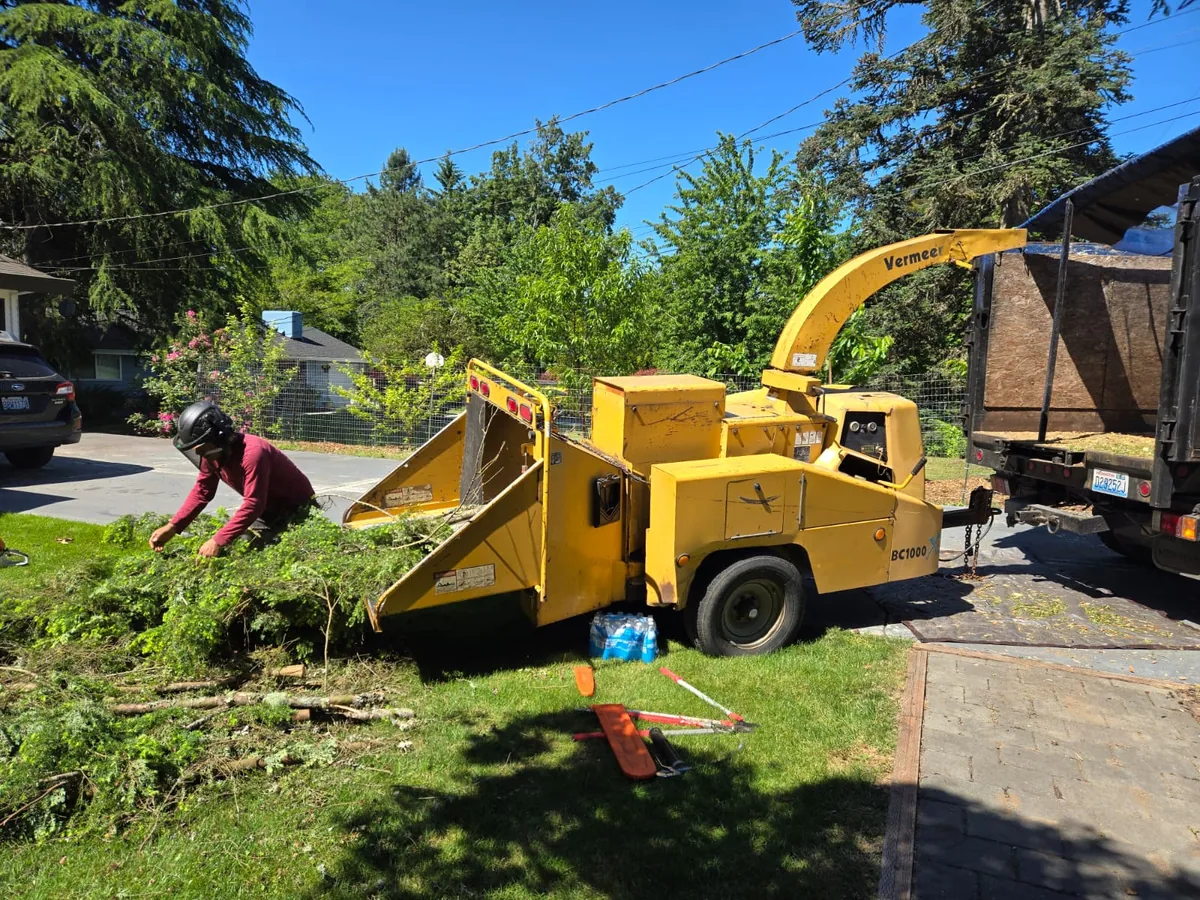
Wood chipper and tree material at a residential work site during debris processing.
When Does a Tree Situation Become More Urgent?
While most tree condition observations can be evaluated during a routine on-site estimate, certain situations require prompt safety measures:
- Freshly uprooted trees or active root heaving: A tree actively moving or tilting during storms requires immediate perimeter clearance.
- Large broken hanging branches: Suspended limbs caught in the canopy can fall without warning. Keep people and vehicles clear of the drop zone.
- Fallen trees impacting structures or driveways: If a tree has already fallen, follow our step-by-step emergency instructions in What to Do Immediately When a Tree Falls on Your Property.
- Utility line contact: If tree branches or trunks are touching power lines, stay well clear and immediately contact your serving electric utility (Puget Sound Energy at 1-888-225-5773 or Seattle City Light) and 911.
What Information Should You Have Ready Before Requesting an Estimate?
When scheduling an on-site tree service estimate, gathering a few basic details from a safe ground location helps the crew review the scope of work efficiently:
- Identify the specific tree(s): Note the location on your property (front yard, back yard, near property line).
- Note visible symptoms: Be prepared to describe what you observed (e.g., dead branches, fungal growth, sudden lean, or root disturbance).
- Timeline of changes: If known, note whether the condition developed recently (such as after a specific storm) or has been present for years.
- Property access: Note any gates, narrow side yards, septic drain fields, or underground utilities in the work area.
Important: Always observe trees from a safe ground vantage point. Never climb trees, enter unstable areas, or dig around root plates to gather information.
Key Safety & Decision Takeaways
- Observations Require Context: A single visible defect does not automatically mean a tree must be cut down.
- Pruning Is Often an Option: Selective branch removal, crown cleaning, or clearance trimming can often resolve specific concerns while preserving the tree.
- Distinguish Leans: Long-standing natural leans are common and stable, whereas newly developed leans with soil heaving require prompt attention.
- No DIY Guesswork: Avoid relying solely on online checklists or DIY scratch tests to make permanent removal decisions.
- Discuss Options On-Site: An in-person review allows property owners to discuss practical tree care and removal options based on their specific landscape.
Sources & Further Reading
- USDA Forest Service: How to Recognize Hazardous Defects in Trees (NA-FR-01-96). Available at: https://www.fs.usda.gov/Internet/FSE_DOCUMENTS/stelprdb5347871.pdf
- Purdue University Extension: Tree Risk Management: Identifying Potential Tree Hazards (FNR-FAQ-12-W). Available at: https://www.extension.purdue.edu/extmedia/FNR/FNR-FAQ-12-W.pdf
- University of Minnesota Extension: How to Manage Tree Decay, Cavities, and Structural Defects. Available at: https://extension.umn.edu/planting-and-growing-guides/how-manage-tree-defects
- University of Maryland Extension: How to Tell If a Tree Is Dead or Dormant. Available at: https://extension.umd.edu/resource/how-tell-if-tree-dead-or-dormant