Do You Need a Permit to Remove a Tree in Renton, WA?
It depends on the tree and the work. The City of Renton requires a Routine Vegetation Management Permit (RVMP) for some tree work on private property, such as removing a landmark tree or removing more than two significant trees in a calendar year. The City also lists conditional exemptions for smaller removals, but those exemptions do not cover work in shorelines, critical areas or critical area buffers. Confirm with the City before cutting.
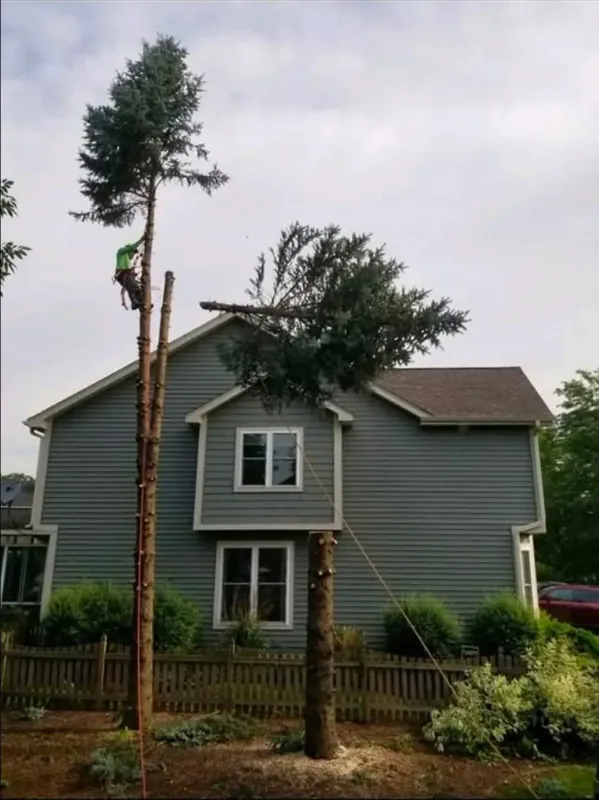
Rope rigging work on a tall tree beside a residential house. Permit questions are best settled with the City before work like this begins.
Few questions come up more often before a removal than this one: can I just cut the tree down, or do I need the City's permission first? In Renton the honest answer is that it depends on the tree, the property, and the work you plan, and the City of Renton is the only party that can tell you for certain. This guide explains what the City says on its official tree removal page, what the permit process looks like, and how to sort out the question before anyone starts a saw.
What Does the City of Renton Say About Tree Removal Permits?
The City's tree removal page explains that tree work on private property is regulated and that a permit may be required before any work begins. The permit it describes is the Routine Vegetation Management Permit, or RVMP, which the City identifies as a Type I permit and notes is commonly known as a Tree Removal Permit. The page points to Renton Municipal Code 4-4-130 for the detailed rules.
The same page separates private-property trees from trees in the public right-of-way. Removal of right-of-way trees is handled through the City's Urban Forest Program rather than through this permit. The City's FAQ describes the right-of-way as typically the strip of land between private property and the road, and says public trees are mapped on its Tree Inventory Map. If the tree you are worried about stands between the sidewalk and the street, that distinction matters, and a quick call to the City will tell you which path applies.
Which Trees Need a Permit?
The City's Urban Forestry FAQ answers this more directly than the permit page does. According to that FAQ, an RVMP is required for:
- Removing a landmark tree. A landmark tree has a diameter at chest height (DBH) of 24 inches or more. For bigleaf maple, black cottonwood and red alder, the threshold is 30 inches or more.
- Removing more than two significant trees in a calendar year. A significant tree has a DBH of at least 6 inches. For alder and cottonwood, it is at least 8 inches.
- Tree removal, trimming, mowing or cutting ground cover, or other vegetation management on a vacant property, especially before development, when building permits have not yet been obtained.
The FAQ points to Renton Municipal Code 4-4-130 for the full rules.
Are There Conditional Exemptions?
Yes, but they come with conditions. The City's FAQ says that, except for tree removal or vegetation management within shorelines of the state, critical areas or critical area buffers, no RVMP is required for:
- Up to three high-risk trees within one year, if no landmark trees are proposed for removal.
- Up to two significant trees within one year, and no more than five within five years, if all of the following apply: there is no active land development permit or application for the site; the tree is not a protected or landmark tree; the tree is not within 10 feet of a surface parking lot with ten or more spaces; the tree is not one of the only two significant trees left on the lot, unless it is high-risk; and rights-of-way stay unobstructed unless a right-of-way use permit is obtained.
- Land clearing for landscaping (lawns, trees, shrubs, flowers and ground cover) that meets the same restrictions.
Two other points from the FAQ are worth knowing. The City cannot assist with clearing trees that fall on private property, so you would hire a contractor. And Urban Forestry cannot visit trees on private property, although it may help answer questions about them.
Who Should You Contact at the City?
The City directs permit questions to Planning Customer Service. Its Urban Forestry FAQ adds that for trees on privately owned property you can contact the Community and Economic Development Department, or reach Urban Forestry through the Renton Responds app. The contact details published on the RVMP page are:
- Phone: 425-430-7294 (Monday through Friday, 8 a.m. to 4 p.m., per the City page)
- Email: planningcustomerservice@rentonwa.gov
- In person: Renton City Hall, 1st Floor Customer Service, 1055 South Grady Way, Renton, WA 98057 (the page lists specific in-person hours, so check them before you go)
When you call or write, have the property address, the number and general location of the trees, and a short description of why you want the work done. Staff can then tell you whether a permit applies and what to submit.
What Does the Permit Process Involve?
The City describes a structured application. The table below summarizes the steps and materials it lists. It is a summary of the City's page, not a replacement for it.
Swipe to view more columns
| Stage | What the City Page Describes | Practical Note for Homeowners |
|---|---|---|
| Application materials | Signed and notarized master application, project narrative, site plan, tree retention plan or planting plan, and an arborist report from a certified arborist or licensed landscape architect. | Gather these early. The City states that applications are not accepted if its file naming convention is not followed. |
| Submittal | Email Planning Customer Service to request an upload link, including the application type, work address and project name. | Submittal follows the process described on the City's page. |
| Fees | Fees are assessed after the application is accepted for review. The page links to the City Fee Schedule and lists no amounts. | Review does not begin until the invoice is paid. |
| Review | Staff review the plans and may send comments or revision requests, sometimes in more than one round. There is no public comment period. | Answer comments promptly to keep the application moving. |
| Decision and appeal period | An administrative decision is issued, followed by a two-week appeal period. The page says no work should begin until that period has ended. | Do not schedule removal for the day the approval arrives. |
How Long Does It Take?
According to the City, Type I permits typically take about three weeks on average to process, plus the appeal period that follows the decision. Two cautions from the same page are worth remembering: an application with no activity for six months is considered abandoned and must be started over, and approvals can carry conditions and expiration dates that you should read before work begins. Treat the three-week figure as the City's average, not a promise for your project.
Practical Steps Before You Hire a Tree Service
Before Removal Is Scheduled
- Call the City first: Ask Planning Customer Service whether your tree and your planned work need a permit.
- Confirm whose tree it is: Know whether the tree is on your property, a neighbor's, or in the public right-of-way.
- Note size and species: The City's thresholds depend on trunk diameter at chest height and, for some trees, species, so write down what you can before you call.
- Record the answer: Note who you spoke with at the City, the date, and what they said.
- Ask contractors about scope: Ask whether the estimate depends on a permit decision.
- Wait for approval: Do not schedule work until the City has confirmed what applies, including any appeal period.
A few more habits help. Take dated photos of the tree before any work. Keep the name of the City staff member and the date of any conversation. Ask each contractor you speak with what the estimate does and does not include, and whether the scope depends on a permit decision. If you are comparing contractors, you can check a company's registration yourself through the Washington L&I contractor verification tool.
How a Tree Service Estimate Fits Into the Permit Question
A contractor's estimate and the City's permit decision are separate things. During a free on-site estimate, a tree care company can walk the property with you, look at access, nearby structures and the work you want done, and describe how tree removal would be carried out. What the estimate cannot do is replace the City's determination. Permit decisions belong to the City of Renton.
If you are not sure what to expect from an on-site visit, our guide to preparing for a tree service estimate covers what to have ready, and our article on what affects a tree removal estimate explains how scope and site conditions shape the proposal. If the tree is close to overhead wires, read what Renton homeowners should do about branches near power lines before anyone climbs.
Frequently Asked Questions
Do I need a permit to remove one tree from my yard in Renton?
Not always, but sometimes. The City's FAQ lists conditional exemptions, such as removing up to two significant trees within one year (and no more than five within five years) when specific conditions are met. A permit is required for removing a landmark tree or more than two significant trees in a calendar year, and the exemptions do not cover shorelines, critical areas or critical area buffers. Call the City with your address and a description of the tree before you cut.
How much does a Renton tree removal permit cost?
The City says fees are set after an application is accepted for review and refers applicants to its Fee Schedule. The RVMP page lists no dollar amounts, so we do not quote any here.
What if the tree is dangerous or has already fallen?
If a tree has fallen on a structure or there is immediate danger, call 911 first and keep everyone away. The City's FAQ says it cannot assist with clearing fallen trees on private property, so you would hire a contractor. It also lists an exemption for up to three high-risk trees within one year, but it does not explain how "high-risk" is determined, so ask the City before relying on it. Our guide on what to do when a tree falls on your property covers the next steps.
Can my tree service apply for the permit for me?
The City describes an application with required documents, including an arborist report. Ask any contractor in advance what they can and cannot help with, and remember that the permit decision itself is the City's.
Planning Tree Removal in Renton?
Just For Trees LLC is a residential tree care company based in Renton, WA. We provide free on-site estimates for homeowners in Renton and surrounding service areas. Call (253) 553-8953 or request a free estimate online, and let us know if you are still waiting on a City answer so we can plan around it.
Sources & Further Reading
- City of Renton: Tree Removal (Routine Vegetation Management Permit, RVMP). Available at: https://www.rentonwa.gov/City-Services/Permit-Services/Land-Use-Development/Tree-Removal-Routine-Vegetation-Management-Permit-RVMP
- City of Renton Urban Forestry: Frequently Asked Questions. Available at: https://yourvoice.rentonwa.gov/urban-forestry/widgets/91594/faqs
- Washington State Department of Labor & Industries (L&I): Verify a Contractor, Tradesperson or Business. Available at: https://secure.lni.wa.gov/verify/